Hot foil stamping is one of the few finishing processes that can lift perceived brand value at a glance—if you control the variables that make or break consistency. The economics are changing fast: servo motion, closed-loop registration, foil-saving strategies, and recipe-driven setups are shrinking makeready and waste, which directly improves OEE and payback.
This guide explains what a hot stamping machine is, how it works, the main machine types and components, and where automation features matter most for engineers, printers evaluating equipment, and procurement leaders modeling ROI.
A hot stamping machine transfers a thin decorative foil layer to a substrate by pressing a heated die against foil positioned between the die and the material. Heat, pressure, and dwell time release the desired layers from a polyester carrier and bond them to the surface, creating high-gloss metallics, pigments, or holographic effects with crisp edges.
Scope note: This article covers hot foil stamping for printing and packaging (labels, cartons, and plastic components), not metallurgical “hot stamping” of steel in automotive.
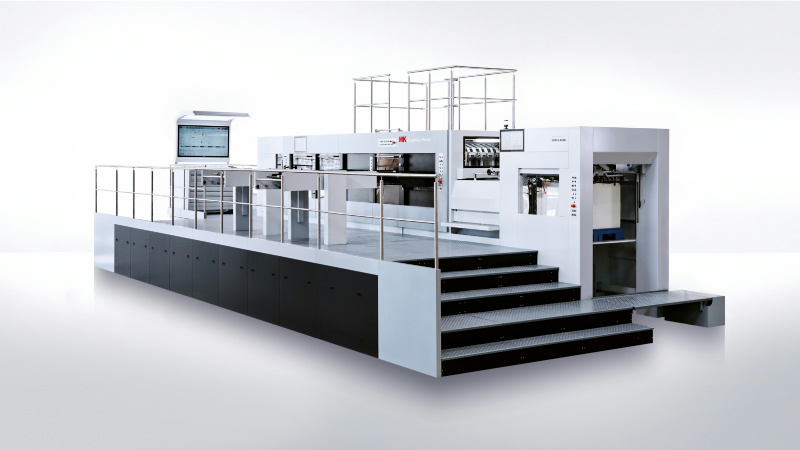
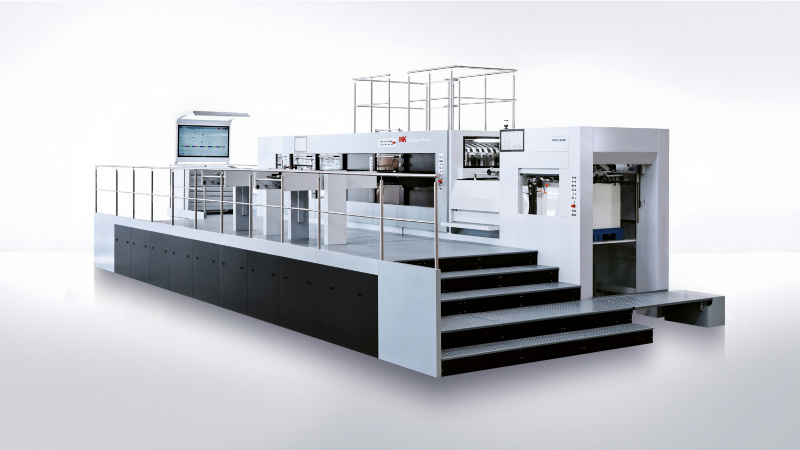
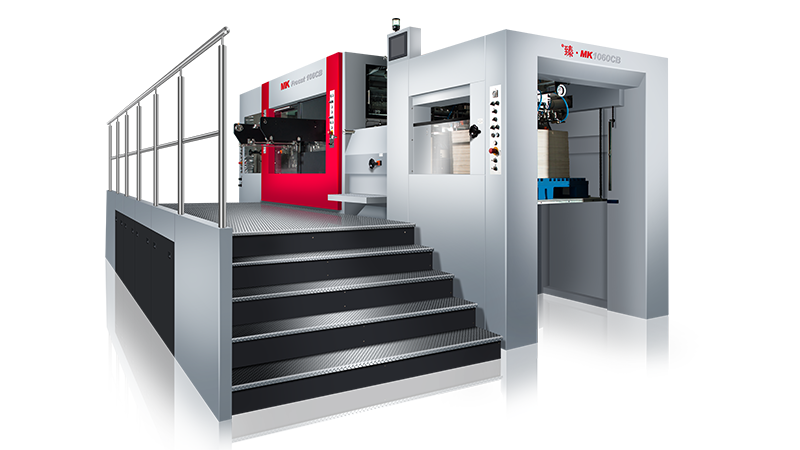
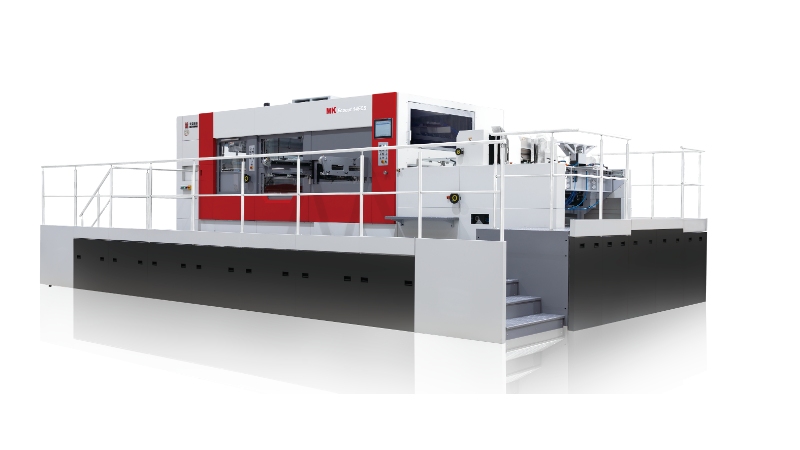
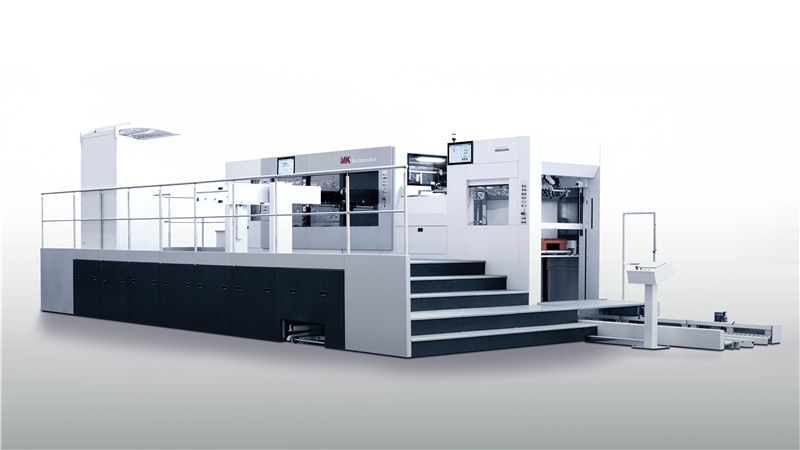
Masterwork automatic hot stamping machine Duopress Power 106FCSB
Think of foil as a multi-layer film engineered to let specific layers peel away under heat and pressure. A typical foil stack includes a PET carrier, release layer, topcoat and color/effect layers, an ultra-thin vacuum-metallized aluminum layer for metallic effects, and a heat-activated adhesive tailored to the substrate.
The process is governed by three interdependent variables:
Temperature: sufficient to activate the adhesive and aid release without scorching or distortion.
Pressure: ensures intimate surface contact and compensates for micro-topography.
Dwell time (or nip time in rotary): allows heat flow and bond formation.
Under-transfer (poor adhesion, missing detail) or over-transfer (bleed, haloing) usually traces back to this triad, die make-ready, or foil/substrate mismatch.
Different architectures suit different formats, speeds, and integration ambitions.
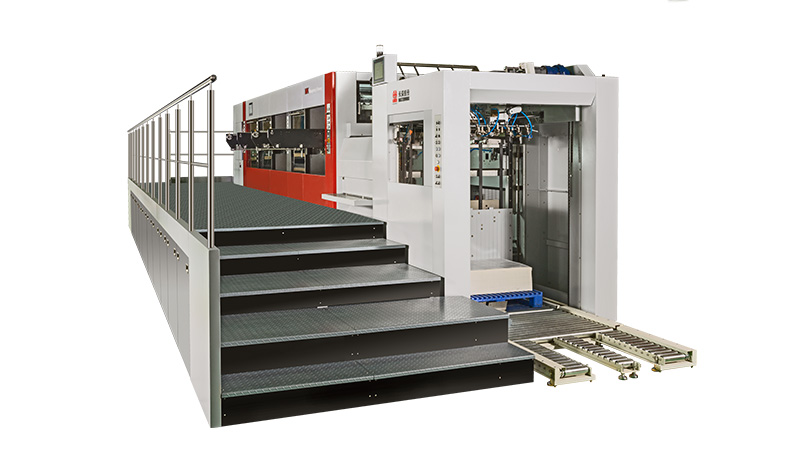
Flatbed/platen (sheetfed or intermittent web): A heated flat die presses onto a stationary sheet or indexed web. Ubiquitous in folding-carton finishing, it excels at deep impressions and combining foil with embossing, with typically longer makeready and lower cyclic speeds than continuous web systems.
Rotary/cylinder-to-cylinder (continuous web): A heated die cylinder transfers foil to a moving web against an impression cylinder. This is common on label lines, enabling high throughput and tight register in continuous motion.
Roll-on inline modules: Motorized hot foil (and screen/emboss) units can be integrated into hybrid lines alongside flexo or offset.
Inline vs offline: Inline simplifies logistics and can reduce WIP and changeovers for multi-process jobs, while offline flatbed die-cutters with hot foil units offer maximum pressure and format flexibility for luxury work. Your mix of SKUs, run lengths, and need to combine processes should drive this choice.
Below are the core subsystems you’ll evaluate; modern implementations add sensors and servo control to stabilize each function.
Subsystem | Function in the process | Engineering notes |
|---|---|---|
Heating system + die tooling | Heats engraved brass/copper/magnesium plate (flat) or cylinder to activate foil adhesive and release | Stable temperature under load; die material and relief depth affect detail and dwell |
Foil unwind/rewind and tension control | Feeds fresh foil and takes up spent carrier with uniform tension | Automatic tension and guides prevent wrinkles, breaks, and misregister; dancer/encoders feed back to PLC |
Registration and sensors | Aligns foil image to printed graphics or die relief | Marks/encoders/cameras with closed-loop correction improve first-pass yield |
Impression/pressure system | Applies force uniformly via platen or impression cylinder | Make-ready balances uneven stock; excess pressure increases wear and waste |
Web transport / sheet handling | Moves substrate with controlled acceleration and deceleration | Servo drives stabilize motion profiles and shorten setup |
HMI, recipes, safety/guarding | Stores setpoints, guides setup, protects operators | Recipe recall reduces variation; interlocks and guarding are essential |
Optional modules | Emboss/deboss, screen varnish, cold foil, inline vision | Combination builds premium effects and enables closed-loop quality |
Here’s where modern machines earn their keep. The goal is fewer stoppages, faster ramp-up, and higher first-pass quality.
Servo motion and closed-loop registration: Synchronized drives and feedback from marks or cameras reduce mechanical tweaking, hold register at speed, and buffer against drift. Industry trend roundups for labels and converting consistently list automation and inline integration as the productivity engines for recent years (Labels & Labeling: 2025 predictions).
Automatic foil tension and web handling: Stable cross-web and machine-direction tension prevent wrinkles that cause non-transfer or scuffing. OEM process documentation frames tension and foil path stability as core to consistent transfer .
Recipes and quick-change tooling: Digital setpoint recall (temperature, nip load, foil stepping, register) and modular tooling reduce changeover minutes and operator variability. Guided, recipe-driven setups are proven levers for OEE gains in discrete manufacturing, and they apply directly to finishing workflows like hot stamping.
Inline vision inspection: Cameras can catch non-transfer, misregister, or blemishes early and trigger corrections or stops, keeping long runs from drifting off spec. A representative integrator case study in label inspection (not foil-specific) documented a 32% throughput increase and 315% first-year ROI after automating inspection and reject handling—directional evidence for the value of closed-loop quality on decorated label lines (Visionify inline label inspection case study).
Data connectivity and guided setup: MES/ERP ties, OEE dashboards, and software like process-monitoring suites for hot stamping help standardize best-known settings and flag anomalies early. Masterwork have introduced machine-insight platforms to monitor temperatures, cycles, and quality triggers in real time for hot stamping.
Practical tip: Baseline today’s changeover time, scrap percentage, run speed to stable, unplanned stops, and first-pass yield across 3–5 representative SKUs. During demos or trials, validate whether servo registration, tension automation, recipes, and vision shorten setup and lift yield on your substrates and foils. That’s your payback model.
Foil is a recurring cost. Well-implemented saving features can materially improve unit economics without compromising quality.
Common methods include cross-web stepping (shifting impressions laterally to use more foil width), skip-and-repeat (advancing foil only where needed), nesting multiple small images within a repeat, and optimizing the path (leader/trailer and angle) to reduce waste. Education on foil processes underscores that layout/stepping and careful registration control are the primary levers, while “percent savings” varies by job mix and geometry . Treat savings as empirical: measure meters of foil per finished unit before and after a single change, include setup scrap, and compute payback from your actual SKU blend.
Hot stamping shines in categories where tactile metallics and pinpoint edge fidelity matter, and where durable decoration is a brand cue.
Labels: Wine & spirits, gourmet foods, and specialty labels often require tight register with print and varnish; inline or hybrid lines combine foil with print in one pass. Trade education on combination presses explains how inline units share register and reduce handling.
Folding cartons and rigid boxes: Luxury cartons in cosmetics, spirits, and confectionery lean on flatbed hot foil and emboss combinations for relief and shine. Relief depth and die quality drive premium effects, particularly on coated boards.
Plastics and rigid components: For premium goods, roll-on processes apply foils to plastics, provided temperature and dwell are tuned to avoid deformation.
Substrate cautions:
Paper/board generally tolerates higher pressure and heat but benefits from fully cured coatings/primers and uniform make-ready.
Films/plastics often require lower temperature and shorter dwell; surface energy treatment (e.g., corona) may be necessary. Always test on the actual finished construction (printed/coated/laminated) before committing a long run.
Each method has a clear “best use” profile. Think of this comparison as a practical decision aid for equipment selection and job routing.
Method | Where it excels | Trade-offs and notes |
|---|---|---|
Hot foil stamping | Highest edge fidelity; deep relief with emboss; durable metallic look on labels, cartons, and plastics | Requires engraved dies and makeready; separate heat/pressure station; best for premium static designs |
Cold foil transfer | Inline with flexo/offset via UV adhesive; fast changeovers; overprintable metallics and gradients; good for heat-sensitive webs | Relief requires separate emboss; metallic appearance differs; adhesive/UV curing adds variables |
Digital embellishment (foil/varnish) | No dies; minimal setup; true variable data; ideal for short runs and personalization | Metallic depth/texture differs from hot foil; speed/coverage limitations; consumables cost profile differs |
Decision cue: For high-SKU mixes with frequent art changes and moderate coverage, cold foil or digital may reduce changeover burden. For flagship SKUs where tactile metallics and crisp micro-detail are brand-critical, a hot foil station—often with emboss—still sets the benchmark.
Hot and cold transfer foils deposit an extremely thin metal layer on paper/board. Industry summaries citing the Foil & Specialty Effects Association (FSEA) report the aluminum layer thickness is on the order of tens of nanometers—hundreds of times thinner than household foil—which supports compatibility with standard repulping when mills accept decorated grades . Foil suppliers also note that transferred layers are very light—often lighter than conventional printing inks—and that foil-decorated paper can be recyclable where accepted (Univacco sustainability statement). Always confirm with local mills and MRFs; policies vary.
Energy use depends on the line: hot stamping consumes heat to maintain die temperature, while cold foil relies on UV/LED curing energy. Robust third-party LCAs comparing the two in identical contexts are limited in the public domain, so model energy as part of your site trials.
What mix of SKUs, formats, and changeover cadence will the press see over a quarter? Map jobs to flatbed, rotary, or inline modules accordingly.
Which automation features are must-have to stabilize OEE on your substrates: servo registration, automatic tension, recipe recall, quick-change tooling, inline vision, and data connectivity?
Do your key SKUs benefit from emboss-with-foil relief? If so, ensure pressure capacity and die/tooling workflows support that effect.
How will you baseline today’s changeover time, scrap, and first-pass yield and validate gains in demos/pilots? Include foil-saving features in the trial plan.
What service, spare parts, and training model will reduce mean time to repair and dependence on scarce expert operators?
Inline integration and hybridization: Converters continue to consolidate steps, adding hot foil and screen modules into flexo/offset/digital lines for one-pass production and less WIP.
Data connectivity, guided setup, and predictive maintenance: From recipe libraries to process-monitoring dashboards, software support is helping stabilize quality amid skilled-labor constraints. Vendors now offer machine-insight tools to monitor temperatures, cycles, and alarms in real time for hot stamping .
Sustainability focus: The industry continues to clarify recyclability compatibility for decorated paper and to improve energy efficiency.
If you’re evaluating a hot stamping machine today, anchor the decision in your SKU mix and OEE constraints. Servo motion, closed-loop registration, automatic tension, recipe/quick-change, inline vision, and data connectivity aren’t buzzwords—they’re the levers that shorten makeready, steady run speeds, and lift first-pass yield. Validate those levers on your own substrates, foils, and artwork, measure foil consumed per finished unit, and let the data guide whether hot foil, cold foil, or a digital embellishment path delivers the best return for each job family.
Products
Contact us
Related Information
Content

We look forward to hearing from you. In order to respond to your message more quickly, we need some information. *These are required