For hot foil stamping, there is no single temperature, pressure, or machine speed that works for every job. The correct settings depend on the foil grade, substrate, stamping area, die design, surface coating, machine type, and required production speed.
For many general-purpose metallic foils used on paper and paperboard with platen presses, foil manufacturers specify working temperatures around 90–120°C or 110–140°C, depending on the foil grade. These values should be treated as starting references rather than universal settings because temperature is directly related to machine speed and substrate conditions.
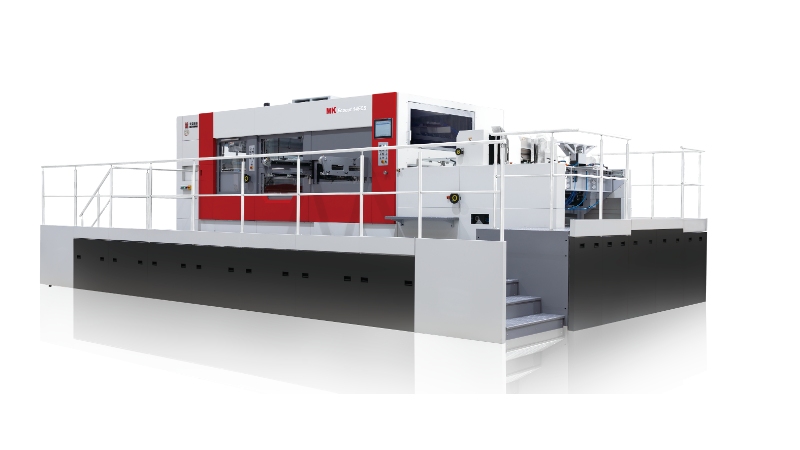
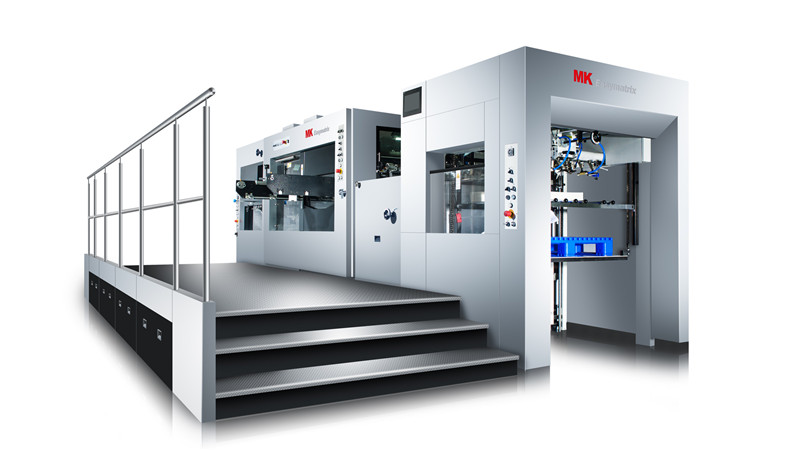
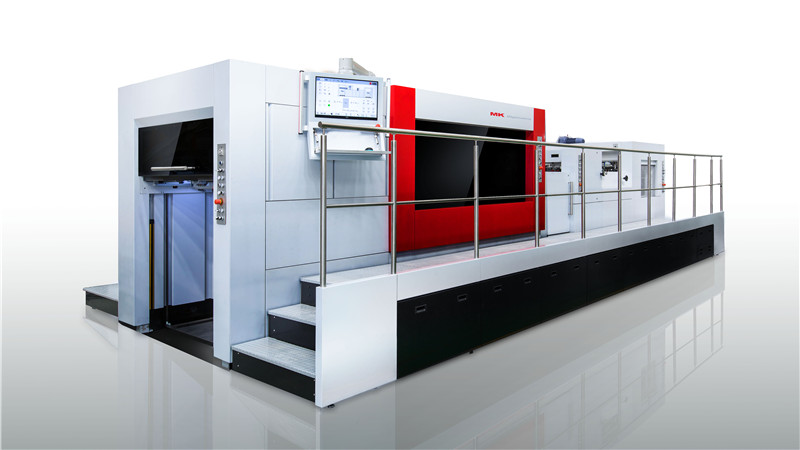
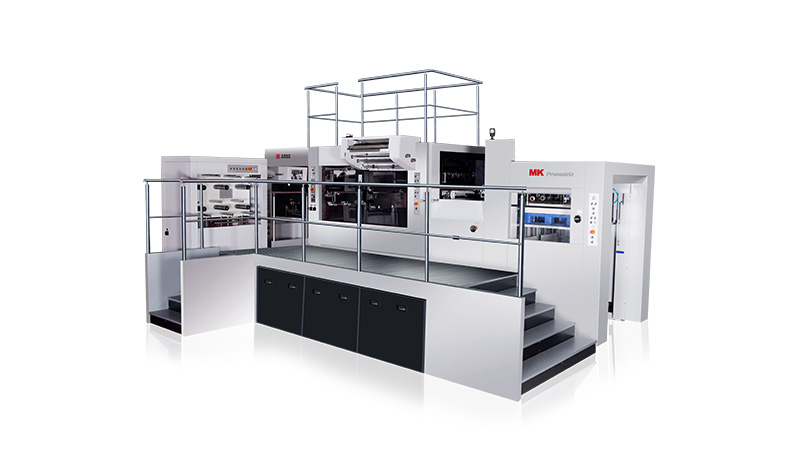
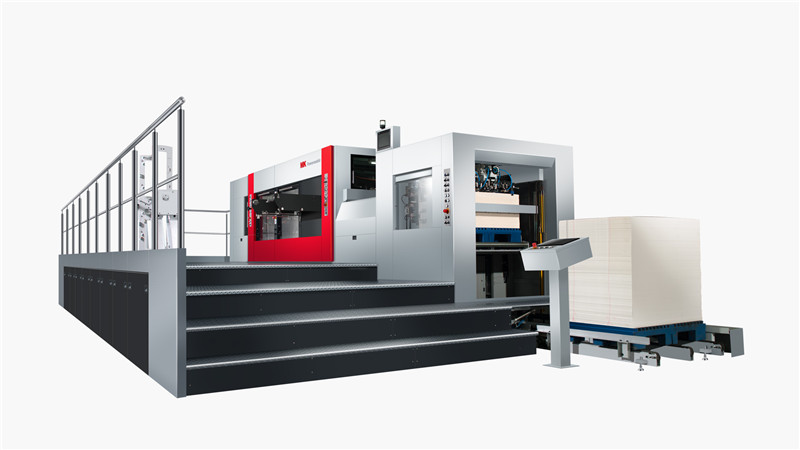
Industrial foil stamping machines may offer a much wider operating range. For example, the Masterwork Duopress 106FCSB provides 40–180°C temperature control across 20 heating zones, while its maximum hot foil stamping speed is listed at 5,000 sheets per hour. The Promatrix 106FC provides up to 180°C with 20 heating zones and a maximum hot foil stamping speed of 7,500 sheets per hour.
The practical goal, however, is not to use the highest temperature, pressure, or speed. It is to find the lowest temperature and pressure that produce complete, clean foil transfer at the highest stable production speed.
Hot foil stamping depends primarily on three interconnected variables:
Temperature + Pressure + Contact Time
On an automatic sheet-fed machine, contact time is closely related to machine speed.
Temperature activates the release and adhesive layers of the foil.
Pressure ensures close contact between the die, foil, and substrate.
Speed determines how much time heat and pressure have to act on the foil and material.
Changing one variable often means the other two need to be adjusted.
For example:
Increasing machine speed reduces effective contact time.
Lower contact time may require more heat.
Increasing heat too much may create blurred edges or substrate distortion.
Increasing pressure may improve incomplete transfer, but too much pressure can crush board or fill fine details.
This relationship is why good foil stamping setup should always consider all three variables together.
For many paper and paperboard applications on platen presses, a practical working area is often somewhere around 90–140°C, but the actual requirement depends heavily on the foil grade.
For example, Foilco lists certain general-purpose metallic foils for platen applications at approximately 90–120°C, while another grade suitable for coated and laminated paper and board is listed at 110–140°C. The manufacturer specifically notes that these temperatures are guidance because working temperature is related to machine speed.
This is an important distinction:
The machine's temperature range tells you what the equipment can provide. The foil supplier's recommended temperature tells you where you should begin testing.
A machine capable of 180°C does not mean packaging should normally be stamped at 180°C.
| Situation | Likely Adjustment |
|---|---|
| Foil does not transfer completely | Increase temperature gradually |
| Fine details are filling in | Reduce temperature and/or pressure |
| Foil edges look blurred | Reduce temperature |
| Production speed increases | Temperature may need to increase |
| Heat-sensitive substrate | Use lower temperature and suitable foil |
| Large solid foil area | Stable and uniform heat becomes more important |
| Difficult coating or varnish | Different foil grade or additional heat may be required |
| Foil is sticking outside the image | Temperature may be too high |
These are troubleshooting directions rather than fixed settings.
Not all hot stamping foil is constructed the same way.
A typical foil contains several layers, including:
PET carrier
Release layer
Color or lacquer layer
Metallic or decorative layer
Adhesive layer
Different foil grades use different release and adhesive systems.
Some are designed for:
Fine detail
Large-area stamping
Coated board
Uncoated board
Laminated surfaces
Plastics
High-speed production
Foilco, for example, classifies different foil grades according to substrate, stamping process, and application, and recommends considering the substrate, machinery, and foiling method when choosing foil.
Therefore, changing from one foil supplier or foil grade to another may require a new temperature setting even if the substrate and artwork remain unchanged.
The surface receiving the foil plays a major role.
Smooth coated board often allows efficient foil transfer because the surface provides good contact with the die.
However, coatings, varnishes, UV inks, or laminations can change adhesion behavior.
A foil that performs well on untreated paperboard may require different settings on UV-coated board.
Uncoated paper may absorb heat differently and generally has a more porous or textured surface.
Successful transfer may require adjustments to:
Pressure
Foil grade
Temperature
Make-ready
Simply increasing temperature may not solve problems caused by surface roughness.
Film-laminated packaging requires a foil grade compatible with the film surface.
Temperature should also remain within the safe range of the laminate.
Plastic materials require particular attention because excessive temperature may cause:
Warping
Shrinkage
Surface damage
Dimensional instability
For heat-sensitive substrates, the solution may be a foil designed to release at a lower temperature rather than simply changing machine pressure.
Pressure is more difficult to express as one universal number than temperature.
Industrial platen foil stamping machines are often specified by their maximum working or cutting pressure.
For example:
Masterwork Duopress 106FCSB: up to 2.5 MN / 250 t
Easymatrix 106FC: up to 2.6 MN / 260 t
Promatrix 106FC: up to 3.0 MN / 300 t
Duopress Power 106FCSB: up to 2.6 MN
But these values are machine capacity specifications, not recommended foil stamping settings.
This distinction is critical.
You should not interpret a machine with 300 tons of maximum pressure as meaning every foil stamping job should run anywhere near 300 tons.
Actual pressure depends on:
Total stamping area
Number of dies
Die size
Fine detail vs solid coverage
Substrate thickness
Surface texture
Make-ready
Embossing requirements
The correct principle is:
Use enough pressure to achieve complete and uniform transfer, but no more than necessary.
Insufficient pressure commonly causes:
Missing foil
Weak transfer
Patchy solid areas
Incomplete edges
Uneven coverage
Poor transfer on textured materials
Before increasing pressure substantially, however, check whether the real cause is:
Insufficient temperature
Incorrect foil grade
Uneven make-ready
Damaged die
Surface coating incompatibility
Pressure should not be used to compensate for every foil stamping problem.
Excessive pressure can cause:
Heavy impression marks
Crushed paperboard
Loss of fine detail
Foil spreading beyond the image
Distorted small text
Excessive die wear
Damage to corrugated structures
For premium folding cartons, excessive pressure can be particularly problematic because the foil may appear visually correct while the board underneath is permanently deformed.
This is why modern industrial equipment provides controlled pressure adjustment rather than simply relying on maximum force.
For example, Masterwork's Easymatrix 106FC includes motorized pressure adjustment, while its hot-foil computer system can be used to adjust temperature and die-cutting pressure and save job data.
A 20 × 20 mm logo and a 500 × 600 mm metallic background cannot be treated the same way.
A small logo concentrates force across a relatively small area.
A large solid foil design requires uniform pressure over a much greater surface.
This means pressure requirements are influenced by the total active die area, not simply sheet size.
Large-area foil stamping also places greater demands on:
Platen flatness
Die mounting
Pressure distribution
Heating uniformity
Substrate consistency
Therefore, when evaluating machine capacity, packaging manufacturers should provide the supplier with the actual foil artwork—not only the sheet format.
Machine specifications give a maximum production speed, but actual foil stamping speed depends on the job.
Masterwork's current product specifications illustrate the difference between machine models:
| Machine | Max. Hot Foil Speed | Temperature Capability | Heating Zones |
|---|---|---|---|
| Duopress 106FCSB | 5,000 sheets/hour | 40–180°C | 20 |
| Easymatrix 106FC | 6,500 sheets/hour | Up to 180°C | 20 |
| Promatrix 106FC | 7,500 sheets/hour | Up to 180°C | 20 |
| Duopress Power 106FCSB | Up to 7,000 sheets/hour* | 40–180°C | 20 |
Actual speed and accuracy vary according to the product type.
These numbers describe machine capability. They do not mean every packaging job should automatically run at maximum speed.
A large-area foil job, hologram registration job, difficult substrate, or complex embossing application may require a lower stable production speed.
Imagine a foil stamping job running successfully at a certain speed.
If the machine speed is increased, each sheet spends less effective time in the stamping cycle.
The foil therefore has less time to:
Receive heat.
Release from the carrier.
Contact the substrate.
Form a reliable bond.
This may lead to incomplete transfer.
That explains why foil manufacturers warn that recommended stamping temperature is related to machine speed.
In practice:
Higher speed → shorter contact time → potentially more heat or other process adjustment
But simply increasing temperature every time speed increases is not always the correct solution.
If temperature becomes excessive, quality can deteriorate in a different way.
The objective is to find a balanced production window.
Consider three common production situations.
Possible causes include:
Temperature too low
Pressure too low
Speed too high
Wrong foil grade
Poor substrate compatibility
A sensible adjustment sequence would be:
Check foil and substrate → check temperature → verify pressure uniformity → reduce speed if necessary
Do not immediately maximize pressure.
Possible causes include:
Temperature too high
Pressure too high
Die detail too coarse
Foil release characteristics unsuitable
Try reducing temperature or pressure before slowing production unnecessarily.
This strongly suggests a process-window issue.
Increasing speed reduces contact time.
The operator may need to:
Increase temperature slightly
Check foil release characteristics
Confirm heating uniformity
Verify pressure
Select a foil designed for higher-speed production
The goal should be to identify which variable is limiting production rather than changing all parameters simultaneously.
A structured setup process makes troubleshooting much easier.
Start with the recommended:
Substrate
Machine type
Temperature range
Application type
Detail capability
If the foil supplier recommends 90–120°C for platen stamping, that is a much better starting point than choosing a random machine temperature.
Do not perform final testing only on plain paper if the real job uses:
Printed board
UV varnish
Film lamination
Specialty coating
The final surface determines foil adhesion.
Avoid starting at the highest possible temperature.
Begin inside the foil manufacturer's recommended range.
Pressure should be uniform across the entire stamping area.
Correct make-ready is often more important than simply increasing total machine pressure.
First obtain:
Complete transfer
Sharp edges
Correct registration
Clean foil release
Then increase production speed progressively.
If temperature, pressure, and speed are all changed together, it becomes difficult to determine which adjustment actually solved the problem.
A controlled approach is:
Temperature → Pressure → Speed
while also checking foil and substrate compatibility.
For repeat packaging jobs, saved production data can reduce setup time significantly.
Masterwork's Hot-foil Computer System, for example, supports temperature and pressure adjustment, foil feeding calculations, foil-feed simulation, and job data storage on applicable models such as the Easymatrix 106FC.
Large-format industrial hot stamping is different from small manual foil stamping.
A large die may contain:
Several logos
Wide metallic areas
Fine decorative details
Multiple stamping positions
Uniform heating becomes critical.
If one section of the platen is significantly cooler than another, the operator may see:
Good foil transfer on one side
Incomplete transfer on another
Uneven metallic appearance
Localized adhesion problems
This is why machines such as the Easymatrix 106FC, Promatrix 106FC, Duopress 106FCSB, and Duopress Power 106FCSB use 20 heating zones for controlled hot foil production.
Multiple heating zones allow temperature to be managed more precisely across the working area instead of treating the entire platen as one uniform heating surface.
| Problem | Temperature | Pressure | Speed | Also Check |
|---|---|---|---|---|
| Incomplete foil transfer | Increase gradually | Increase slightly if needed | Reduce if necessary | Foil grade, coating |
| Missing areas | Check heat uniformity | Check pressure uniformity | Reduce if unstable | Make-ready, die |
| Blurred edges | Reduce | Reduce | Usually unchanged | Foil release |
| Fine details filling in | Reduce | Reduce | Can sometimes increase | Die design |
| Poor transfer at higher speed | Increase slightly | Verify first | Reduce if required | High-speed foil grade |
| Board crushing | Usually unchanged | Reduce | Usually unchanged | Make-ready |
| Plastic deformation | Reduce | Review | Increase cautiously | Substrate heat resistance |
| Uneven large-area foil | Check heating zones | Check pressure distribution | Reduce during testing | Die flatness |
| Foil sticking outside image | Reduce | Check excessive pressure | Review | Foil grade |
This table should be used as a diagnostic guide rather than as a fixed recipe.
Not necessarily.
Higher temperature can sometimes compensate for shorter contact time, but excessive heat can create new defects.
Possible consequences include:
Dirty edges
Excessive foil release
Loss of detail
Substrate distortion
Foil sticking
Damage to coatings
Reduced process stability
The better goal is to identify a stable process window where several variables have enough tolerance to accommodate normal production variation.
A process that works only at exactly 127°C and fails at 125°C or 129°C is less reliable than one that produces acceptable results across a reasonable operating range.
Industrial production should therefore optimize process stability, not merely obtain one perfect sample sheet.
Suppose a cosmetics carton uses smooth coated paperboard and requires a small metallic gold logo.
A practical setup could begin with:
A foil grade recommended for coated board.
The foil supplier's platen temperature range—for example, around 90–120°C if specified for that particular grade.
Moderate pressure sufficient to produce complete transfer.
A controlled machine speed during make-ready.
Incremental speed increases after stable quality is achieved.
Because the stamping area is relatively small, extremely high pressure is unlikely to be necessary.
The priorities are:
sharp detail + clean edges + precise registration + stable production speed.
Now consider a carton with a large solid gold panel.
The challenges change.
The operator must pay more attention to:
Temperature uniformity
Pressure distribution
Die flatness
Foil release
Surface smoothness
Machine rigidity
Simply increasing temperature may make one part of the image transfer correctly while creating over-release elsewhere.
This type of application benefits from equipment with controlled heating zones and stable pressure distribution.
When foil stamping is combined with embossing, pressure requirements can become more demanding.
The process must simultaneously produce:
Reliable foil transfer
Correct image definition
Required embossing depth
Acceptable paperboard deformation
Machines intended for premium packaging therefore need both substantial pressure capacity and precise pressure adjustment.
But again, maximum machine pressure should be viewed as available capacity rather than the normal production setting.
When discussing a new foil stamping application, it is more useful to provide the supplier with production information than to simply ask:
"What temperature should I use?"
Provide:
Material type
Grammage or thickness
Surface coating
Lamination
Foil supplier and grade
Sheet size
Stamping area
Fine detail or large solid area
Number of foil positions
Required embossing
Target production speed
Annual production volume
This allows the machine supplier and foil supplier to evaluate the complete process.
For example, Masterwork machines cover different production requirements. The Easymatrix 106FC is specified for paper from 90 g/m², solid board up to 2,000 g/m², and corrugated board up to 4 mm, with hot foil speeds up to 6,500 sheets per hour. The Promatrix 106FC increases published hot foil speed to 7,500 sheets per hour, while the Duopress series combines foil stamping with additional converting processes.
For most packaging applications, the answer can be summarized as follows:
Temperature: Start with the foil manufacturer's recommended range. For many general-purpose metallic foils used on platen machines, approximately 90–140°C is a common supplier-specified range, depending on foil grade and substrate. Do not assume the machine's maximum temperature is the recommended operating temperature.
Pressure: Use the lowest pressure that produces complete, uniform foil transfer. Maximum machine pressures such as 250 or 300 tons indicate equipment capacity, not normal foil stamping settings.
Speed: Establish clean and stable foil transfer first, then increase machine speed progressively. Actual production speed should remain below the point where incomplete transfer, registration problems, or quality instability begin to appear.
Most importantly:
Do not optimize temperature, pressure, and speed independently. A successful foil stamping process is a balance between all three.
For high-volume packaging production, stable temperature control, uniform pressure, accurate foil feeding, reliable sheet registration, and the ability to save repeat-job settings can be just as important as the machine's maximum speed.
When evaluating an industrial foil stamping machine, manufacturers should therefore compare not only maximum temperature, pressure, and sheets per hour, but also how precisely these parameters can be controlled under real production conditions.
Products
Contact us
Related Information
Content

We look forward to hearing from you. In order to respond to your message more quickly, we need some information. *These are required